From Coding to Orchestrating I started experimenting with spec-driven development while using AI to help implement features, and I expected the biggest improvement to be speed. But speed wasn’t what impressed me the most. It was clarity. Very quickly, a pattern showed up: If the spec was vague, the
Chris
From Coding to Orchestrating
I started experimenting with spec-driven development while using AI to help implement features, and I expected the biggest improvement to be speed. But speed wasn’t what impressed me the most. It was clarity.
Very quickly, a pattern showed up:
- If the spec was vague, the code was vague.
- If the spec was missing constraints, the code made risky assumptions.
- If the spec was clear, structured, and specific, the output was surprisingly solid.
Now read that again, but replace the word “spec” with “requirements.” This problem has always existed in software development. AI didn’t create this problem — it exposed it.
And then something clicked for me: Agentic AI was not just about fast coding - it's about clear thinking.
Clarity > Coding
But if AI can now generate functions, endpoints, tests, and documentation, then writing code is no longer the main bottleneck.
The bottleneck is — and really always has been:
- Do you understand the problem?
- Can you define the business rules?
- Can you identify edge cases?
- Can you define constraints and guardrails?
- Can you clearly describe what “done” means?
Frameworks are tools. Languages are tools. AI is a tool. Clarity is the skill.
Coding doesn’t make you an engineer.
Clarity makes you an engineer.
Prompting vs Spec-Driven Development
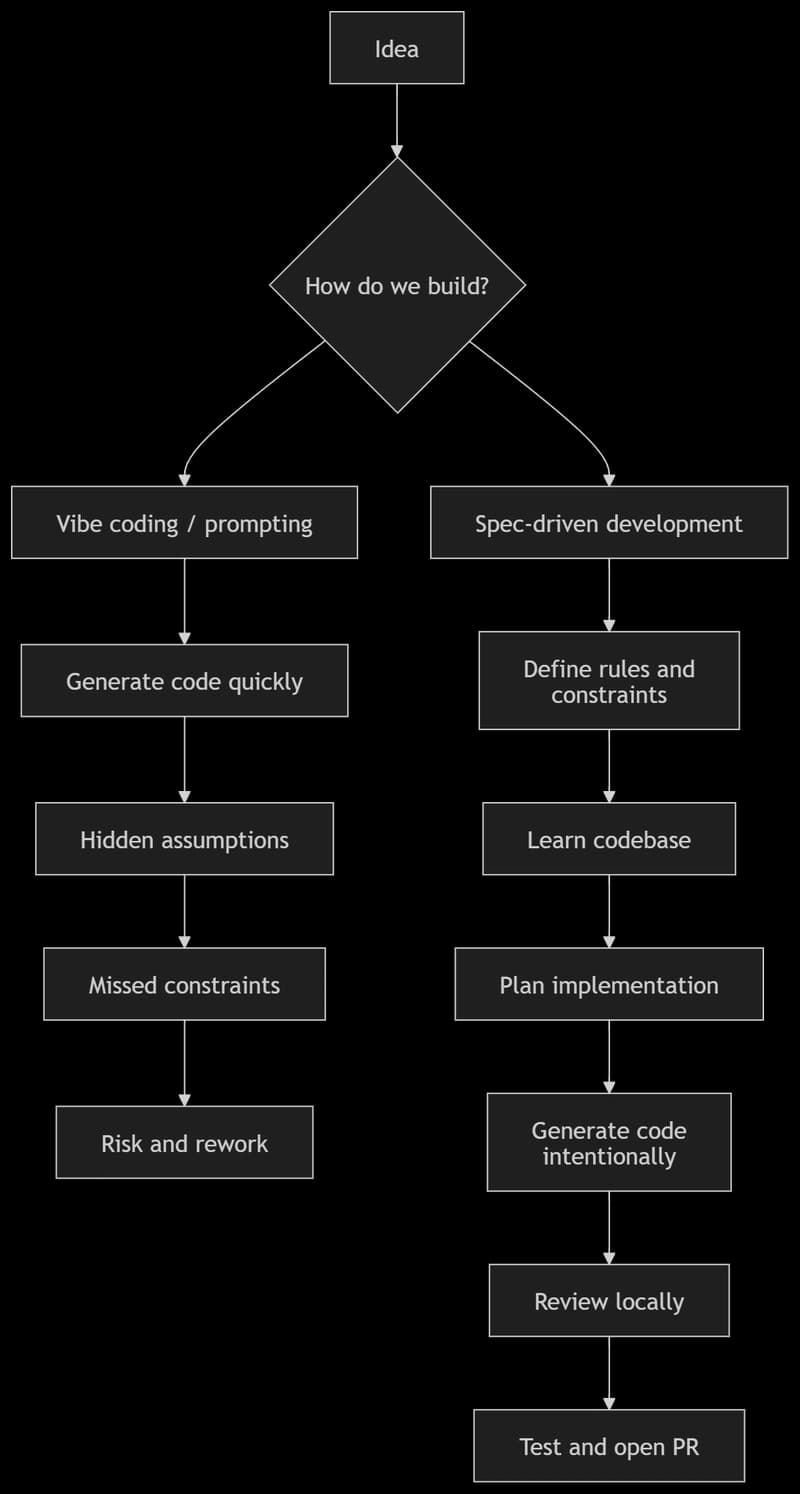
A lot of people are “vibe coding” right now — prompting, getting something that looks right, and iterating from there. That can be useful for exploration, but it’s very risky in real systems.
Here’s the difference:

Prompting generates code quickly. Spec-driven development generates code intentionally and more accurately. The difference is guardrails and clarity.
From Coding to Orchestrating: Agentic Spec-Driven Development
Once you have a solid spec, the workflow starts to change. You’re no longer just writing code — you’re guiding the process.
A simple agentic spec-driven workflow follows the same phases as traditional programming.
Phase 1: Requirements
Specification --> Learn codebase --> Create a plan
Phase 2: Coding
Implement --> Review --> Approve --> Test
Phase 3: Hand-Off
Commit --> PR
The main shift for programmers is from:
“I write all the code.”
to:
“I define the system, set instructions and guardrails, review what gets produced, and then refine.”
You simply move from coding a solution to orchestrating a solution.
Autonomous Spec-Driven Development
The next step is when this process is triggered automatically — for example, when a Jira ticket is assigned.

Notice what doesn’t disappear: the developer. It isn't about replacing the developers. It's about assisting and accelerating them. The developer becomes: the spec writer, the system designer, the reviewer, the person responsible for guardrails and correctness.
The implementation becomes more automated, but the engineering responsibility does not.
Accelerated Engineering
People talk a lot about "AI making developers faster," or the much-feared "AI is going to take our jobs," but the biggest benefit I'm seeing isn't about the speed - it's accelerated learning and accelerated engineering.
Spec-driven + AI means you can: prototype faster, explore faster, document faster, refactor faster. You get to try more ideas in less time and learn unfamiliar parts of the codebase faster!
Not because thinking is skipped — but because clear thinking becomes reusable.
A good spec can be used to:
- Generate code
- Generate tests
- Generate documentation
- Validate behavior
- Onboard new developers
- Drive automation
The speed comes from reuse and clarity, not from skipping steps.
From Coding to Orchestrating
I don’t think developers are going away. But I do think the job is moving up a level. Less time wiring up CRUD. More time understanding the business, writing specs, designing systems, defining constraints, and orchestrating tools.
AI isn’t about removing the engineer. AI is forcing us to become better engineers. And I think that's pretty exciting! Because in the end:
Coding doesn't make you an engineer. Clarity does.
I’m curious how other developers are approaching this. Are you starting to move toward spec-driven workflows?
Found this useful? Share it!
Read the Full Story
Continue reading on Dev.to
Related Stories
Majority Element
about 2 hours ago
Building a SQL Tokenizer and Formatter From Scratch — Supporting 6 Dialects
about 2 hours ago
Markdown Knowledge Graph for Humans and Agents
about 2 hours ago
Moving Beyond Disk: How Redis Supercharges Your App Performance
about 2 hours ago