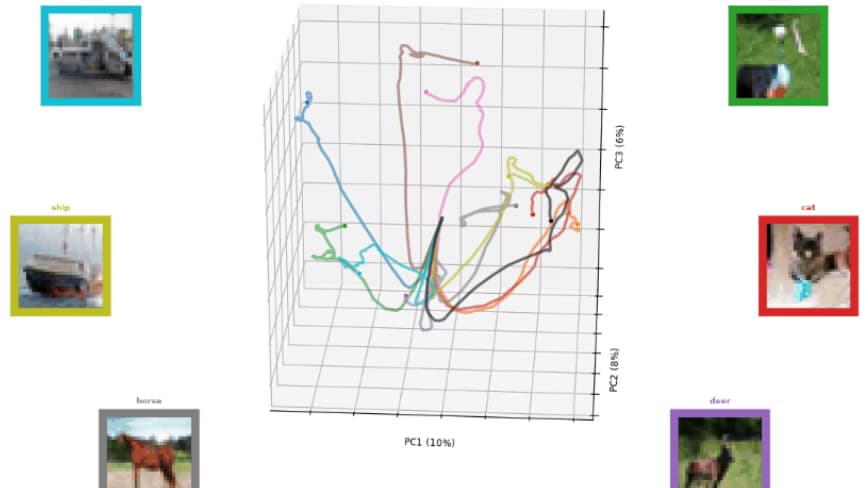
Unconventional AI, the startup founded by former Databricks AI chief Naveen Rao, has released its first AI model, an image generation system called Un-0 that runs on a completely new kind of computing architecture. The model produces results comparable to state-of-the-art diffusion models like Stabl
Key Insights
10 editorial insights.
Unconventional AI's Un-0 model represents a paradigm shift in artificial intelligence by utilizing oscillator architecture, which diverges from traditional silicon chip designs. This innovation could lower energy consumption by a factor of a thousand, creating a compelling case for businesses to adopt more sustainable AI solutions and potentially reshaping industry standards for efficiency.
The Un-0 model's ability to process data through oscillators allows it to leverage principles of quantum mechanics, marking a significant advancement in computational efficiency. As major players like OpenAI and Google continue to dominate with high-resource diffusion models, Unconventional AI's approach could challenge existing paradigms, especially in sectors where energy costs are a critical concern.
With the AI market increasingly prioritizing sustainability, the launch of Un-0 aligns with global trends toward reducing carbon footprints. Companies engaged in AI development may find themselves pressured to adopt technologies like Un-0 to remain competitive, especially as regulatory frameworks begin to focus on environmental impacts associated with energy consumption in tech industries.
The implications of Un-0's efficiency extend beyond mere computational power; they could democratize access to advanced AI technologies in resource-constrained environments. By significantly reducing energy costs, smaller firms and startups in developing markets, such as India, may gain the ability to compete with larger corporations, fostering innovation across the tech landscape.
Unconventional AI's introduction of the Un-0 model could catalyze a shift in investment strategies within the tech sector, particularly as venture capital increasingly targets sustainable technologies. Investors may prioritize companies that demonstrate the ability to reduce energy consumption while maintaining high performance, potentially leading to a reallocation of funds into greener tech solutions.
The oscillator architecture employed in Un-0 also holds potential for applications beyond image generation, including areas such as natural language processing and real-time data analytics. As industries seek more efficient AI tools, the versatility of Un-0 could open doors to new market opportunities, encouraging broader adaptation across diverse sectors.
As Unconventional AI positions itself as a potential disruptor, it could prompt established firms like Google and Microsoft to accelerate their own sustainability initiatives. The competitive landscape may shift as these tech giants feel the pressure to innovate in energy efficiency, leading to rapid advancements across AI technologies.
The timing of Un-0's release is critical, as the AI sector grapples with rising energy costs and environmental scrutiny. Companies that fail to adjust to the growing demand for sustainability may risk losing market share to more innovative competitors who can deliver similar performance with significantly lower energy requirements.
The successful execution of Un-0's architecture could inspire further research and development in unconventional computing methods, paving the way for future breakthroughs in AI. If adopted widely, this could create a ripple effect, encouraging a broader exploration of alternative technologies that prioritize efficiency and sustainability.
In light of Un-0’s potential, educational institutions may begin to incorporate unconventional computing principles into their curricula, preparing future technologists for a landscape that increasingly values efficiency. This shift in educational focus could help cultivate a generation of innovators equipped to tackle the challenges of sustainable AI development.
Unconventional AI has launched its first model, Un-0, which operates on a groundbreaking oscillator architecture. This innovation could potentially reduce energy consumption in AI systems by a staggering factor of a thousand, marking a significant shift in the field of artificial intelligence and its sustainability.
The Un-0 model utilizes a novel oscillator-based computing architecture that diverges from traditional silicon chip designs. By employing oscillators to process data, this technology aims to harness the principles of quantum mechanics and signal processing to achieve higher efficiency and lower power consumption. Unlike conventional models that rely on extensive power-hungry computations, Un-0's design streamlines operations, allowing for rapid image generation while minimizing energy use. This could revolutionize how AI models are developed and deployed, especially in resource-constrained environments.
The launch of Un-0 comes at a time when the AI landscape is rapidly evolving, with major players like OpenAI and Google investing heavily in diffusion models. These models have set a high bar for image generation capabilities, but they also demand substantial computational resources. Unconventional AI's approach, which promises comparable output quality with drastically reduced energy costs, positions it as a potential disruptor in a market increasingly focused on sustainability and efficiency.
In the Indian tech scene, the implications of this new architecture could resonate across various sectors, particularly in startups and companies focused on AI development. Firms like Wipro and Infosys, which are actively investing in AI solutions, may find Un-0's technology advantageous for their projects. Furthermore, the burgeoning AI community in India, particularly among developers and researchers, could leverage this architecture to create more efficient solutions tailored to local needs, thus enhancing India's competitive edge in global tech markets.
Key Highlights
- Unconventional AI has launched the Un-0 image generation model.
- Operates on a revolutionary oscillator architecture, reducing power use by up to 1000x.
- With significant energy savings, this model could attract partnerships in the AI sector.
- Startups and developers focusing on sustainable AI practices stand to benefit most.
- Expect further developments in oscillator technology and its applications in AI within the next year.
Real-World Impact
The immediate effects of Un-0's launch will likely be felt by AI developers and companies focused on energy-efficient solutions. Roles such as AI researchers, software engineers, and product managers will need to adapt to this new technology, potentially reshaping project designs and deployment strategies. Industries like gaming, healthcare, and e-commerce, which increasingly rely on AI for image processing, will also see shifts in how they manage energy consumption and operational costs.
Why This Matters
This launch signifies a pivotal moment in AI development, emphasizing the need for sustainable practices in an industry notorious for its substantial energy footprint. CTOs and developers should reassess their current infrastructure and consider integrating oscillator-based technologies to stay competitive and environmentally responsible. This shift could lead to a broader adoption of green AI initiatives across different sectors.
As Unconventional AI continues to refine its oscillator architecture, the industry should closely monitor its developments. The potential for integrating such technologies into existing systems could redefine performance standards in AI, paving the way for a more sustainable future.
Found this useful? Share it!