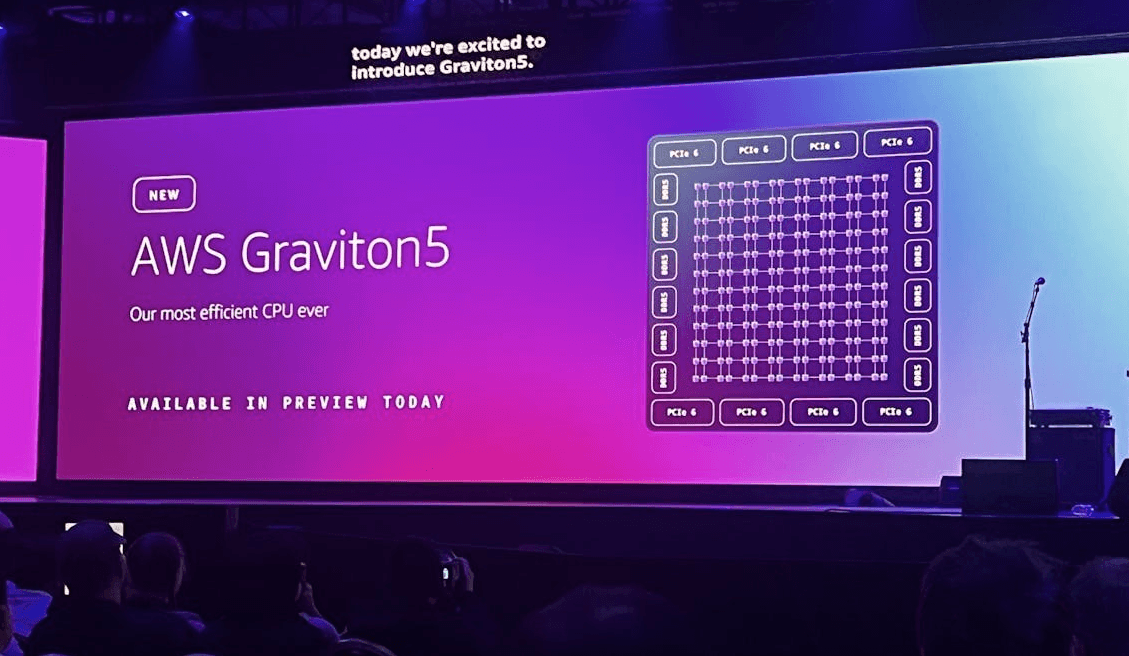
Amazon Web Services Inc.‘s next-generation silicon is working its way deeper into the company’s cloud compute infrastructure offerings with the debut of the new Amazon EC2 C9g and EC2 C9gd instances today. The new virtual machines are powered by the company’s flagship AWS Graviton5 processors, which
Key Insights
10 editorial insights.
Amazon Web Services has launched its new EC2 C9g and C9gd instances powered by Graviton5 processors, marking a significant enhancement in high-performance cloud applications. This move highlights AWS's commitment to improving computational efficiency and cost-effectiveness, as Graviton chips are designed to outperform traditional x86 architectures while lowering operational costs for clients.
Key players in this development include Amazon, which is doubling down on its proprietary silicon to gain an edge in the cloud computing market, and chip manufacturers like Intel and AMD, who face increasing pressure. The introduction of Graviton5 represents a strategic pivot in AWS's approach to managing workloads, particularly as competition intensifies among cloud service providers.
The strategic importance of AWS's Graviton5 CPUs lies in their potential to disrupt the cloud computing landscape by offering more energy-efficient and cost-effective solutions. As enterprises increasingly adopt cloud-native architectures, the ability to provide superior performance at a lower cost could fundamentally reshape market dynamics and client preferences.
For businesses and developers, the adoption of C9g instances can lead to substantial cost savings, with AWS estimating up to 40% lower pricing compared to comparable x86 instances. This could enhance profitability for startups and scale operations for larger enterprises, making high-performance computing more accessible to a broader range of users.
This launch aligns with a broader trend towards custom silicon in the cloud, as seen with companies like Google and Microsoft investing heavily in their own chips. Over the past 12-24 months, the focus on optimizing cloud infrastructure for performance and cost-efficiency has intensified, indicating a shift toward specialized solutions tailored for distinct workloads.
The cloud computing market is projected to reach $1.5 trillion by 2028, growing at a compound annual growth rate (CAGR) of approximately 16.3%. AWS's advancements with Graviton5 CPUs could significantly contribute to this growth, especially as more companies migrate to cloud platforms for their computational needs.
However, the rapid adoption of Graviton5 introduces challenges, such as potential compatibility issues with existing applications and the need for developers to optimize their software for ARM architecture. Additionally, there are questions about the long-term scalability of these solutions in highly variable workloads.
In response to AWS's advancements, competitors like Microsoft and Google may accelerate their own silicon development efforts or enhance their existing offerings. The potential for a silicon arms race among cloud providers could lead to rapid innovations and price adjustments in the market, benefiting consumers.
Over the next 6-12 months, key milestones to watch will include the performance benchmarks of Graviton5 in real-world applications and the adoption rates among enterprises. Regulatory scrutiny around data privacy and cloud service standards may also impact how these technologies are deployed and managed in the market.
For technology professionals and investors, the significance of AWS's Graviton5 deployment lies in its implications for cloud strategy and financial performance. As AWS continues to innovate, understanding these shifts will be crucial for aligning investments with emerging trends in cloud computing and infrastructure efficiency.
Amazon Web Services (AWS) has launched its new EC2 C9g and C9gd instances, powered by the Graviton5 CPUs. This advancement marks a significant leap in cloud computing performance, enabling businesses to handle complex workloads with enhanced efficiency and lower costs. Given the increasing demand for high-performance computing, this innovation is crucial as companies pivot towards more scalable and efficient cloud solutions.
The newly unveiled EC2 C9g and C9gd instances leverage AWS's Graviton5 processors, which utilize ARM architecture to optimize performance for a variety of workloads. These instances are designed to deliver superior processing power, enhanced memory bandwidth, and support for advanced machine learning and artificial intelligence applications. The Graviton5 chips incorporate features such as a high core count and improved floating-point performance, enabling developers to execute compute-intensive tasks more rapidly and with reduced latency.
In the broader tech landscape, AWS faces stiff competition from major players like Microsoft Azure and Google Cloud, both of which are also investing heavily in custom silicon for performance enhancement. AWS's recent announcement positions it favorably within a rapidly evolving market where companies are prioritizing cost efficiency and performance. According to recent industry data, cloud adoption is on the rise, with the global cloud computing market expected to reach $1 trillion by 2026, underscoring the importance of such innovations.
In India, the launch of Graviton5-powered instances is poised to significantly impact the local tech ecosystem. Indian startups and enterprises engaged in sectors such as fintech, e-commerce, and AI-driven solutions can leverage these high-performance instances to scale their operations and enhance service delivery. Notable Indian companies like Zomato and Flipkart, which rely on cloud infrastructure for their operations, stand to benefit immensely from this upgrade, enabling them to process data more efficiently and improve user experiences.
Key Highlights
- AWS introduces EC2 C9g and C9gd instances powered by Graviton5 CPUs
- Graviton5 CPUs offer improved performance and lower costs compared to traditional CPUs
- Cloud computing market projected to reach $1 trillion by 2026
- Indian startups and enterprises in fintech and e-commerce are key beneficiaries
- Anticipate more advancements in AWS's silicon technology in the coming year
Real-World Impact
The introduction of Graviton5 CPUs will directly affect cloud engineers, data scientists, and IT managers across various industries. Specifically, those working in high-performance computing, data analytics, and AI development are set to gain from improved processing capabilities. As companies adopt these new instances, job roles focused on cloud architecture and optimization will become increasingly vital, reflecting a shift in skill requirements within the tech industry.
Why This Matters
This development signifies a crucial trend towards custom silicon in cloud computing, which allows businesses to optimize performance while reducing operational costs. CTOs and developers should consider integrating Graviton5 instances into their cloud strategy to harness these efficiencies. This shift towards ARM architecture also reflects a broader industry movement, prompting organizations to rethink their infrastructure choices and invest in specialized solutions.
As AWS continues to advance its silicon technology, companies should keep an eye on upcoming developments and enhancements. The ongoing evolution of cloud services, particularly with the integration of custom processors, will shape the future of computing and enterprise solutions.
Found this useful? Share it!