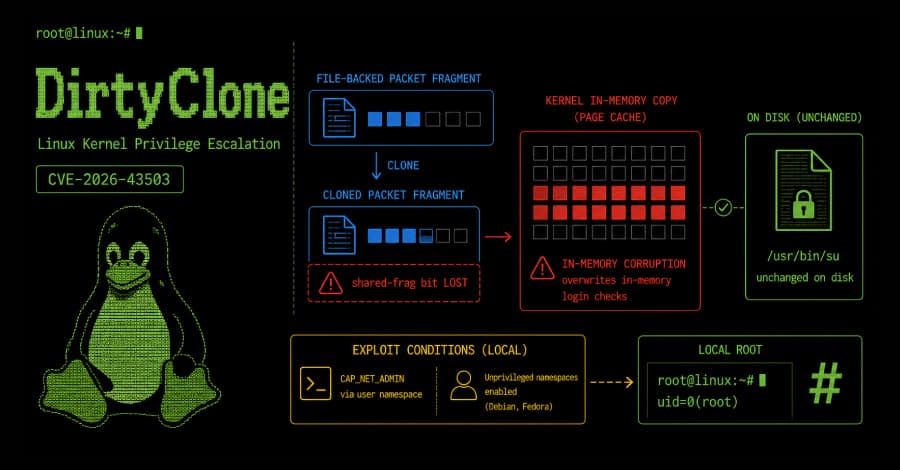
DirtyClone is a new Linux kernel privilege escalation in the DirtyFrag family. JFrog Security Research published a working exploit walkthrough for the flaw on June 25, the first public demonstration for this variant. Tracked as CVE-2026-43503 (CVSS 8.8), it lets a local user corrupt file-backed memo
Key Insights
10 editorial insights.
The emergence of the DirtyClone vulnerability in the Linux kernel, identified as CVE-2026-43503, poses a significant risk as it allows local users to escalate privileges to root by exploiting cloned packets. This flaw not only highlights inherent weaknesses in the kernel but also raises concerns about the security posture of various Linux distributions, given their widespread usage in enterprise environments.
JFrog Security Research's public demonstration of the DirtyClone exploit is crucial as it puts the spotlight on the company's role in cybersecurity, particularly in open-source software. Their involvement underscores the importance of proactive vulnerability research and highlights the ongoing collaboration required between security firms and software developers to mitigate risks.
This development is strategically important as it underscores the ongoing vulnerabilities present in operating systems that underpin cloud infrastructures and enterprise environments. With companies increasingly adopting Linux for critical applications, the implications of such vulnerabilities could lead to significant operational disruptions and increased scrutiny from stakeholders and regulators.
For companies that rely on Linux systems, particularly in sectors like finance and healthcare, the DirtyClone vulnerability could necessitate urgent patches and updates, impacting IT budgets and resources. If unaddressed, organizations could face not only operational risks but also reputational damage should exploits be utilized in data breaches or other malicious activities.
The DirtyClone flaw is indicative of a broader trend where sophisticated vulnerabilities are being discovered at an alarming rate, reflecting the increasing complexity of software systems. Over the past 12-24 months, there has been a marked rise in privilege escalation vulnerabilities, as attackers become more adept at exploiting underlying system weaknesses in widely-used platforms.
The global Linux operating system market, valued at approximately $15 billion in 2022, is expected to grow steadily at a CAGR of around 20% over the next few years. The DirtyClone vulnerability could impact this growth trajectory as enterprises might reconsider the security robustness of their Linux deployments, potentially affecting market confidence and investment in Linux-based solutions.
This vulnerability raises primary risks around the potential for widespread exploitation by malicious actors, especially in multi-tenant environments commonly seen in cloud services. Unresolved questions remain regarding the patching timelines of major distributions and the effectiveness of mitigations to prevent similar future exploits.
Competitors in the cybersecurity space, including established firms like Palo Alto Networks and emerging players focusing on vulnerability scanning, will likely enhance their offerings to address this evolving threat landscape. Expect increased marketing of security solutions that promise rapid response capabilities to emerging vulnerabilities like DirtyClone.
In the next 6-12 months, key milestones to watch include the release of patches from major Linux distributions and potential regulatory responses to increased vulnerabilities in widely-used software. Companies like Red Hat and Canonical will be crucial players in rolling out timely updates and engaging with their user communities to ensure compliance and security.
For technology professionals and investors, the DirtyClone vulnerability serves as a clarion call to prioritize security in software development and deployment. The financial implications of failing to address such vulnerabilities can be substantial, making it essential for stakeholders to invest in robust security practices and stay informed about emerging threats.
A recently identified vulnerability in the Linux kernel, dubbed DirtyClone, has raised alarms within the cybersecurity community. This flaw, tracked as CVE-2026-43503, allows local users to escalate privileges to root level through a specific method involving file-backed memory corruption. The implications of this vulnerability are significant, particularly as organizations increasingly rely on Linux-based systems for critical applications.
DirtyClone is categorized under the DirtyFrag family of vulnerabilities and marks a concerning entry in the realm of privilege escalation threats. By exploiting this flaw, local attackers can manipulate memory management features to gain unauthorized root access. The exploit affects specific versions of the Linux kernel, allowing for the corruption of file-backed memory, which can lead to a complete compromise of the system's security. The technical intricacies involve the mishandling of memory control structures, which can be leveraged to execute arbitrary code with elevated privileges.
This vulnerability arrives during a period of heightened scrutiny on cybersecurity across industries, particularly in sectors that utilize Linux for server management and cloud infrastructure. The release of a public exploit walkthrough by JFrog Security Research on June 25 has put additional pressure on organizations to address their security postures. As more companies transition to microservices and containerized applications, the risks associated with kernel vulnerabilities like DirtyClone become even more pronounced.
In the Indian tech landscape, where Linux-based systems are widely adopted among startups and established enterprises alike, the implications of DirtyClone cannot be overstated. Companies in sectors such as fintech, e-commerce, and cloud services must prioritize patching and monitoring their systems to mitigate potential exploits. Indian developers and system administrators are advised to stay informed of updates from the Linux community and implement security best practices to protect sensitive data and maintain system integrity.
Key Highlights
- Security experts released a public exploit for DirtyClone.
- The vulnerability has a CVSS score of 8.8, indicating high severity.
- Organizations must address this flaw to avoid potential breaches, with Linux usage growing in server markets.
- Companies employing Linux systems in critical operations face the greatest risk.
- Ongoing developments in kernel security should be monitored closely for patches and updates.
Real-World Impact
Immediate consequences of the DirtyClone vulnerability are felt across various roles, including system administrators, cybersecurity professionals, and DevOps teams. These groups must act swiftly to update systems and patch vulnerabilities to prevent unauthorized access. Industries heavily reliant on Linux servers, such as technology, finance, and healthcare, are particularly at risk, highlighting the need for proactive security measures.
Why This Matters
DirtyClone signifies a broader trend in escalating cybersecurity threats related to open-source systems. As more organizations adopt Linux environments, the potential for exploitation increases, underscoring the need for robust security frameworks. CTOs and developers should reevaluate their security protocols and consider adopting more stringent monitoring practices to defend against emerging vulnerabilities.
As the Linux community mobilizes to address the DirtyClone vulnerability, organizations must remain vigilant and prioritize updates. The evolving landscape of cybersecurity threats requires continuous adaptation, and companies should be prepared for similar vulnerabilities in the future.
Found this useful? Share it!