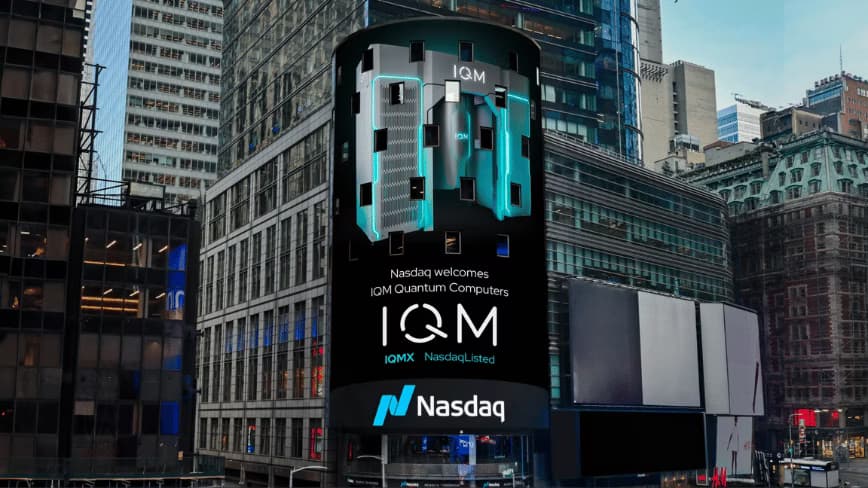
Europe just put its first quantum computing company on a major American stock exchange. And it did so without leaving home. IQM, a Finnish maker of quantum machines, started trading on Nasdaq this week. The debut was equal parts landmark and reality check. IQM began trading on the Nasdaq Global Sele
Key Insights
10 editorial insights.
IQM's debut on the Nasdaq Global Select Market marks a significant milestone for European tech, as it becomes the first quantum firm to trade on a major U.S. exchange. This event not only highlights the growing interest in quantum computing but also emphasizes the potential for European companies to access greater capital markets without relocating operations, setting a precedent for future cross-continental investments.
IQM, a pioneer in quantum computing technology based in Finland, has been a key player in developing superconducting qubits. Their successful entry into the U.S. market showcases their innovative capabilities and positions them alongside established firms like IBM and Google, which are leading the charge in quantum research and commercialization, thus raising the stakes in the global quantum race.
The strategic importance of IQM's listing cannot be overstated as it signifies a shift in the quantum computing landscape, where European firms are now able to compete for investment alongside American giants. This development could accelerate innovation, as access to U.S. capital is crucial for scaling operations and enhancing research capabilities in a sector where rapid advancements are essential.
For developers and end users, IQM's presence on the Nasdaq could lead to increased funding and resources directed toward quantum technology, potentially leading to faster advancements in quantum applications. As businesses begin to explore quantum solutions for complex problem-solving, the availability of a publicly traded company in this space may stimulate partnerships and investment in quantum software development.
Over the past 12-24 months, there has been a noticeable uptick in investments and interest in quantum technologies, with the global quantum computing market projected to grow from approximately $472 million in 2021 to over $8 billion by 2027. IQM's listing reflects this trend, as more firms recognize the transformative potential of quantum computing and seek to capitalize on emerging opportunities in various sectors.
The quantum computing sector is still nascent, with significant uncertainties surrounding the commercialization of the technology. Key metrics, such as the number of qubits and error rates, remain critical to determining market viability, and companies like IQM must overcome these technical hurdles while solidifying their market position amid fierce competition.
Competitors in the quantum space, particularly those in the U.S. such as Rigetti and IonQ, are likely to respond by ramping up their efforts to attract investment and showcase advancements in their quantum technologies. Additionally, this may spur greater collaboration among firms within Europe to strengthen their collective position against U.S. firms, potentially leading to alliances or joint ventures.
In the next 6-12 months, stakeholders should monitor IQM's ability to deliver on its technological promises and engage with regulatory bodies to navigate the complexities of the U.S. market. Milestones such as partnerships with major tech companies and advancements in quantum hardware will be critical indicators of their ongoing success and market acceptance.
The listing of IQM on Nasdaq represents a pivotal moment for technology professionals and investors, as it underscores the increasing recognition of quantum computing as a viable investment opportunity. For investors, this could signal a shift in focus towards emerging technologies that promise significant returns, while professionals in the field may find increased job opportunities and a greater emphasis on quantum skills development.
Ultimately, IQM's successful entry into the U.S. stock market highlights the growing convergence of global tech ecosystems, encouraging further investment and innovation in quantum technologies. This landmark event may inspire other European tech firms to pursue similar paths, thereby enhancing the competitiveness of the European tech landscape on a global stage.
In a historic move, Finnish quantum computing company IQM has become the first of its kind from Europe to trade on a major American stock exchange, specifically Nasdaq. This milestone not only signifies a breakthrough for European tech but also underscores the growing global interest in quantum technologies. The listing reflects a pivotal moment in the quantum race, marking the European Union's ambition to enhance its presence in a market dominated by US firms.
IQM specializes in manufacturing quantum computers aimed at solving complex problems that are beyond the capabilities of classical computers. The company's technology leverages superconducting qubits, which are essential for building scalable quantum processors. This approach allows for improved coherence times and error rates, enabling more reliable quantum computations. IQM's systems are designed to be modular, which facilitates upgrades as technology evolves, providing a pathway to future-proofing quantum solutions.
The quantum computing industry is rapidly expanding, with significant investments and innovations emerging from both established tech giants and startups. Competitors such as IBM, Google, and Rigetti Computing dominate the US market, while European firms are increasingly vying for a share. Reports indicate that the global quantum computing market is projected to exceed $65 billion by 2030, highlighting the competitive landscape and the urgency for companies to secure funding and partnerships.
In India, the impact of IQM's Nasdaq debut could be substantial. The Indian government has initiated a National Mission on Quantum Technologies and Applications to bolster local capabilities. Indian startups and research institutions are already exploring quantum computing applications in healthcare, finance, and logistics. Firms like QNu Labs and the Indian Institute of Science are at the forefront, poised to capitalize on advancements from companies like IQM, fostering collaborations and knowledge sharing.
Key Highlights
- IQM successfully lists on Nasdaq, marking a historic first for Europe.
- Utilizes superconducting qubits for enhanced quantum processing capabilities.
- Quantum computing market projected to exceed $65 billion by 2030, indicating vast potential.
- Indian startups and research institutions stand to benefit from global advancements in quantum tech.
- Future developments expected as IQM continues to innovate and expand its technology offerings.
Real-World Impact
IQM's entry onto Nasdaq is set to influence various sectors, particularly in technology and finance. Job roles in quantum research, software engineering, and data science are likely to see increased demand as companies look to integrate quantum solutions. Industries such as pharmaceuticals and materials science may also experience a shift as quantum computing becomes more accessible, driving innovations in drug discovery and materials development.
Why This Matters
This listing represents a significant shift in the global technology landscape, indicating a maturation of the European tech ecosystem in quantum computing. It suggests that CTOs and developers should prioritize understanding quantum technologies and explore partnerships that can lead to innovative applications. The momentum from IQM's success could inspire other European firms to seek listings on international exchanges, further diversifying the tech market.
As quantum computing continues to evolve, the industry will likely witness increased collaboration across borders, particularly between Europe and Asia. One key aspect to watch will be how Indian companies respond to this landmark event and what strategic partnerships they pursue in the wake of IQM's success.
Found this useful? Share it!