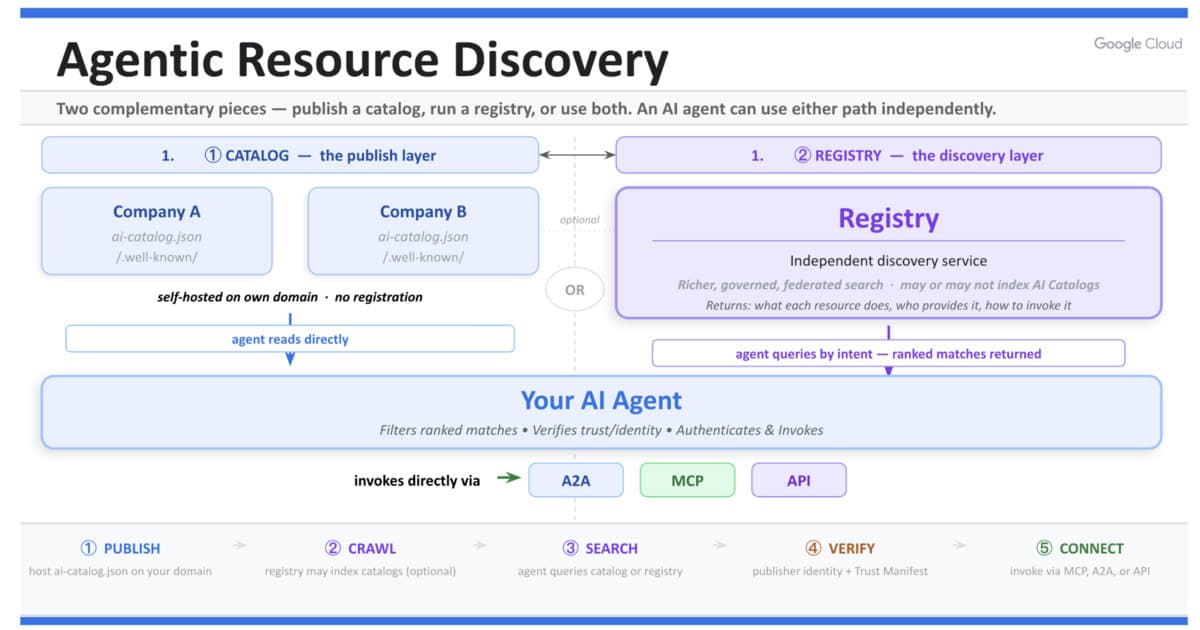
Google and industry partners announced Agentic Resource Discovery (ARD) Specification, an open standard for publishing, discovering, and verifying AI tools, APIs, and agents. ARD introduces a discovery layer built on catalogs and registries, enabling dynamic capability discovery while leveraging exi
Key Insights
10 editorial insights.
Google has introduced the Agentic Resource Discovery (ARD) Specification, an open standard designed to enhance the discovery and management of AI tools, APIs, and agents. This initiative is crucial as it addresses the growing complexity of AI ecosystems, enabling users to dynamically discover and verify capabilities across diverse platforms. With rapid advancements in AI technology, streamlining accessibility is essential for developers and organizations alike.
The ARD Specification creates a robust discovery layer utilizing catalogs and registries to facilitate the dynamic identification of AI resources. This framework allows for the publication, discovery, and verification of various AI tools, streamlining access to APIs and enhancing interoperability. By leveraging existing standards and technologies, ARD aims to provide a unified approach to managing the increasingly intricate web of AI services, ultimately simplifying the integration for developers and users.
In the broader industry landscape, this move comes as AI adoption accelerates across sectors, with companies like Microsoft and IBM also pushing for standardized frameworks. The introduction of ARD could be a game-changer, as it may enable developers to leverage a wider range of AI capabilities without the hurdles of compatibility. As the competition heats up, companies that adopt ARD may gain a significant advantage in rapidly deploying AI solutions.
In India, the tech ecosystem stands to benefit from ARD's introduction, particularly among startups and enterprises looking to implement AI solutions. Indian companies like Wipro and Infosys could leverage this framework to enhance their AI service offerings. Moreover, the initiative may encourage local developers to create innovative applications using various AI tools, boosting the country’s position as a burgeoning hub for AI development.
Key Highlights
- Google introduces the Agentic Resource Discovery Specification
- Enables dynamic capability discovery through catalogs and registries
- AI market projected to grow by 30% in India by 2025
- Startups and enterprises can streamline AI integrations
- Developers can expect ongoing updates to ARD's capabilities in 2024
Real-World Impact
The launch of the ARD Specification may significantly impact developers, AI engineers, and businesses focused on AI integration. Job roles in software development, particularly those involving AI and machine learning, will need to adapt to this new standard. Enterprises looking to innovate with AI can leverage the ARD framework to improve their resource management and deployment processes, ultimately enhancing productivity and efficiency.
Why This Matters
This initiative signifies a strategic shift towards standardization in AI resource management, which is vital for fostering collaboration and innovation in the industry. CTOs and developers should prioritize learning and integrating ARD principles into their workflows to ensure compatibility and streamline development processes. As the landscape evolves, embracing such standards will be essential for maintaining a competitive edge.
Looking ahead, the evolution of the ARD framework will be key to shaping how AI resources are accessed and utilized across various platforms. Observing how quickly the industry adopts this standard will provide insights into the future of AI development.
Deep Analysis
Multi-Source Intelligence
Found this useful? Share it!