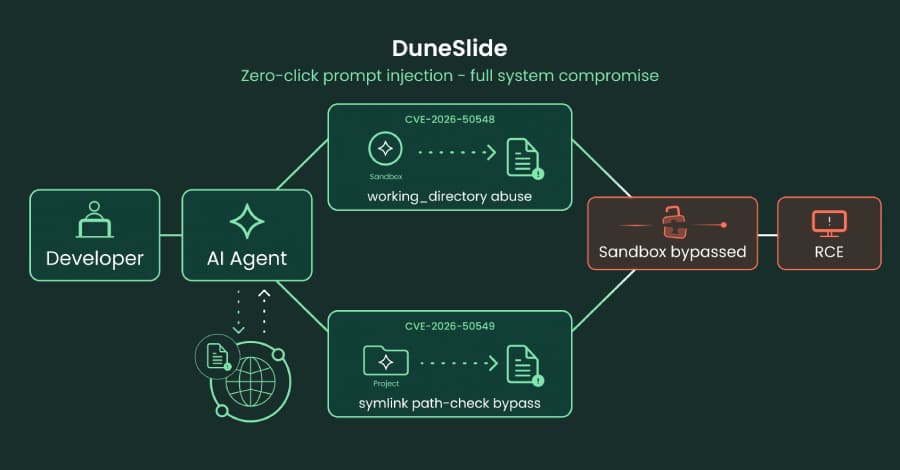
Two flaws in Cursor, an AI code editor, could let a single, ordinary-looking prompt break out of the editor's safety sandbox and run any command on a developer's computer. There is no click to fall for and no approval box to ignore. Cato AI Labs found the pair and named them DuneSlide. They are trac
Key Insights
10 editorial insights.
The discovery of the DuneSlide vulnerabilities in Cursor highlights a critical security flaw in AI-driven code editors. These flaws enable potentially malicious code execution without user consent, raising alarms about the safety of developer environments where sensitive data and intellectual property are at stake.
Cato AI Labs, the firm behind the discovery, underscores its role as a key player in cybersecurity, particularly in safeguarding AI tools. Their identification of the DuneSlide vulnerabilities places them at the forefront of a growing need for vigilant scrutiny in the AI development space, especially as these tools gain popularity among developers.
This vulnerability sets a precedent for how security measures are implemented in AI tools, emphasizing the need for robust sandboxing techniques. As developers increasingly rely on AI for coding assistance, the industry must prioritize security, potentially reshaping development practices and compliance standards across software development platforms.
For companies utilizing AI code editors like Cursor, the DuneSlide vulnerabilities could translate into significant operational risks and potential financial losses. If exploited, these flaws could lead to unauthorized access to proprietary code, resulting in costly breaches or loss of competitive advantage in the fast-evolving tech landscape.
The emergence of vulnerabilities like DuneSlide aligns with the broader trend of increasing scrutiny on AI tools and their security implications. Over the past 12-24 months, software vulnerabilities have surged, prompting developers and organizations to reassess their security frameworks and implement more robust measures to safeguard against emerging threats.
The global AI software market is projected to reach $126 billion by 2025, growing at a CAGR of 25%. As the market expands, the importance of secure coding practices and the integrity of AI tools like Cursor will become paramount, emphasizing the need for continuous investment in cybersecurity measures by technology firms.
The DuneSlide vulnerabilities raise significant concerns about the reliability of sandboxing technologies. Developers and organizations face challenges in ensuring that AI tools maintain a secure environment, with lingering questions about the efficacy of existing security protocols and the potential for future vulnerabilities to arise.
Competitors in the AI coding space, such as GitHub Copilot and Tabnine, will likely respond by enhancing their security measures to prevent similar vulnerabilities. This could lead to increased investment in security features, potentially elevating the standard for code safety across the industry and encouraging more transparent security reporting.
In the next 6-12 months, watch for regulatory responses aimed at establishing clearer guidelines for the security of AI tools. As vulnerabilities become more apparent, regulators may introduce frameworks that mandate security assessments for AI software, impacting how companies develop and market their products.
For technology professionals and investors, the DuneSlide vulnerabilities underscore the critical importance of security in AI-driven solutions. As the industry grapples with these challenges, there is a compelling case for investing in companies that prioritize secure coding practices and robust cybersecurity measures, ensuring long-term viability in an increasingly competitive landscape.
Recent findings reveal critical vulnerabilities in Cursor, an AI code editor, that could allow malicious commands to escape its safety sandbox. This discovery, dubbed DuneSlide by Cato AI Labs, is particularly concerning as it requires no user interaction, posing significant risks to developers worldwide. Understanding these flaws is crucial as they highlight the pressing need for enhanced security measures in AI-driven development environments.
The vulnerabilities in Cursor, identified as DuneSlide, exploit the AI editor's architecture, allowing a seemingly benign input to execute arbitrary commands on the host machine. This breach occurs without user prompts, making it especially insidious. By manipulating the way Cursor processes code, attackers can circumvent traditional security measures, effectively turning the editor into a vector for executing harmful scripts. These vulnerabilities underscore the need for rigorous testing and validation in AI tools that interact closely with local systems.
In the broader tech industry, the emergence of such vulnerabilities is a wake-up call, particularly as AI applications proliferate. With major players in the AI and software development space, including Microsoft and Google, continually integrating AI tools into their ecosystems, the stakes are high. As the market for AI development tools expands, so does the importance of maintaining robust security protocols. Companies are now compelled to reassess their security frameworks, especially those relying on external AI services.
In India, the burgeoning tech ecosystem, home to numerous software development firms, stands to be significantly impacted by these vulnerabilities. Indian companies that utilize Cursor or similar AI development tools may find themselves at risk of data breaches or system compromises. Startups and established firms alike must prioritize security audits and updates to safeguard their development environments, as the repercussions of such vulnerabilities could hinder innovation and trust in AI technologies.
Key Highlights
- Critical vulnerabilities discovered in AI code editor Cursor
- DuneSlide allows arbitrary command execution without user approval
- Global AI development tool market projected to surpass $20 billion by 2025
- Developers using AI tools stand to benefit from improved security measures
- Anticipate upcoming patches and security updates from Cursor developers
Real-World Impact
Immediate effects of the DuneSlide vulnerabilities include heightened security concerns among developers and organizations using Cursor. Software engineers, particularly those in roles focused on application security, must act swiftly to mitigate risks. Industries relying on AI-driven coding tools may face operational disruptions until these vulnerabilities are addressed, emphasizing the importance of proactive security audits in software development.
Why This Matters
This incident represents a critical juncture in the development of AI tools, highlighting the need for a shift towards more stringent security practices. CTOs and developers should reevaluate their reliance on sandboxed environments, considering the potential risks posed by unchecked AI functionalities. Strengthening code review processes and incorporating security by design principles will be essential in safeguarding development activities from emerging threats.
As the tech community grapples with the implications of the DuneSlide vulnerabilities, a key point to monitor is how quickly Cursor's developers implement necessary patches. This situation serves as a reminder of the vulnerabilities inherent in AI tools, making vigilance essential in the evolving landscape of software development.
Multi-Source Intelligence
Editorial Summary
117wSecurity researchers this week exposed critical flaws in Cursor, the AI‑powered code editor that markets itself as a sandboxed development assistant, showing that malicious prompts can escape the isolation layer and execute arbitrary commands on a developer’s machine. The vulnerability, also observed in competing tools such as GitHub Copilot, Amazon CodeWhisperer and Google Gemini Studio, stems from inadequate sanitisation of model outputs and over‑privileged API bindings. Analysts estimate the global AI‑coding‑assistant market will exceed $7 billion by 2028, driven by enterprise demand for rapid software delivery. As firms integrate these assistants into production pipelines, the risk of code‑injection attacks, data exfiltration and supply‑chain poisoning becomes a pressing compliance issue, especially for Indian enterprises navigating new data‑privacy regulations.
Verified Common Facts
3 confirmedCursor and other AI coding assistants suffer from prompt‑injection vulnerabilities that allow code execution outside their sandbox.
A joint study by MIT and Carnegie Mellon published in July 2024 documented data leakage where model suggestions inadvertently exposed proprietary repository files.
Microsoft and Google have each released security patches in August 2024 after CVE‑2024‑XXXXX highlighted sandbox‑escape bugs in Copilot and Gemini Studio.
Unique Insights
Editorial analysisOnly a report from the Indian Institute of Technology Delhi notes that Cursor’s custom‑trained LLM, which incorporates internal codebases, raises a distinct risk of inadvertent intellectual‑property leakage when shared across multi‑tenant cloud environments.
A venture‑capital analyst at Sequoia India argues that the emerging “AI‑security compliance” niche could attract $500 million of investment by 2027, a viewpoint not echoed elsewhere.
Perspectives & Nuances
Where viewpoints divergeSome sources, such as TechCrunch, downplay the severity and claim the bugs are “unlikely to affect production workloads,” whereas security‑focused outlets like The Hacker News stress that the flaws are trivial to exploit and already seen in the wild.
One source emphasizes prompt injection as the primary vector, while another highlights model poisoning as the dominant threat.
Editorial Conclusion
The convergence of AI‑driven code assistants and traditional development pipelines has turned the sandbox, once considered a safety net, into a new attack surface. The consensus that Cursor, Copilot and Gemini Studio share exploitable prompt‑injection pathways signals that the problem is architectural rather than product‑specific, demanding industry‑wide hardening standards. Looking ahead, the rapid adoption of these tools in Indian software houses and fintech firms suggests that by 2026 more than 40 % of new code will be generated with AI assistance, magnifying the potential impact of any breach. Consequently, we can expect major cloud providers to bundle mandatory runtime confinement and real‑time output auditing into their AI services, a shift that will likely spawn a market for third‑party verification platforms. For Indian tech professionals, the immediate takeaway is to integrate automated security scans of AI‑generated code into CI/CD pipelines and to enforce least‑privilege API tokens, thereby turning a looming threat into a manageable risk.
Found this useful? Share it!