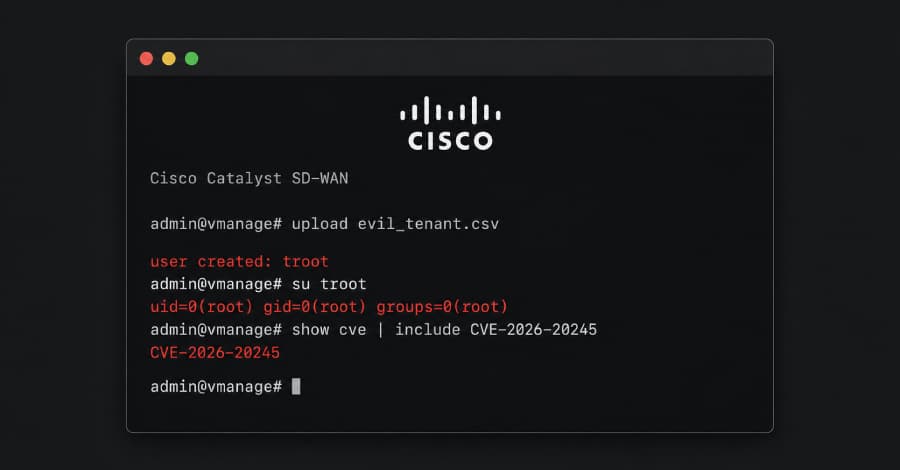
An unknown threat actor exploited a recently disclosed high-severity security flaw impacting Cisco Catalyst SD-WAN as a zero-day at least two months before it was publicly disclosed, according to new findings from Google-owned Mandiant. The vulnerability, tracked as CVE-2026-20245 (CVSS score: 7.8),
Key Insights
10 editorial insights.
The discovery of CVE-2026-20245 underscores a critical vulnerability in Cisco's SD-WAN technology, which could impact thousands of organizations worldwide. With a CVSS score of 7.8, this flaw highlights the urgency for companies to strengthen their cybersecurity measures, particularly as remote and hybrid work models become more prevalent and reliant on such technologies.
Cisco's SD-WAN is widely adopted, making the implications of this vulnerability particularly severe. Organizations utilizing this technology may face not only data breaches but also reputational damage and compliance issues, especially in regulated industries where data integrity is paramount. This incident serves as a reminder of the need for robust incident response strategies.
The fact that CVE-2026-20245 was actively exploited for two months before public disclosure raises concerns about threat intelligence and vulnerability management practices. Companies must enhance their monitoring systems and threat detection capabilities to identify potential exploitation attempts before they result in significant breaches or data loss.
This vulnerability is indicative of broader trends in the SD-WAN market, where the rapid adoption of cloud-based services has outpaced security considerations. As competition heats up among vendors like VMware and Fortinet, ensuring the robustness of their offerings against such vulnerabilities will be critical for maintaining market trust and customer loyalty.
The nature of CVE-2026-20245, allowing root access and arbitrary code execution, suggests that attackers could have wide-ranging control over compromised networks. This level of access can facilitate further intrusions or lateral movements within corporate networks, amplifying the potential impact of the breach, which could include the theft of intellectual property or sensitive customer data.
The rise of hybrid work environments has made SD-WAN solutions increasingly attractive due to their flexibility and scalability. However, this shift also necessitates a reevaluation of security postures, as vulnerabilities like CVE-2026-20245 can be exploited to undermine the very advantages that SD-WAN is supposed to provide, such as seamless connectivity and secure access.
Cisco's vulnerability highlights the systemic risks associated with widespread reliance on single vendors for critical infrastructure. As organizations increasingly adopt a multi-vendor strategy to mitigate these risks, they may also face complexities in integrating solutions that can provide equal levels of security and manageability across diverse platforms.
Given the active exploitation of CVE-2026-20245, organizations must prioritize immediate patching and remediation efforts to safeguard their systems. Failure to address this vulnerability not only exposes them to cyber threats but also potentially invites regulatory scrutiny and financial penalties for non-compliance with data protection standards.
The ongoing evolution of cyber threats necessitates that organizations reassess their security frameworks continuously. The exploitation of vulnerabilities like CVE-2026-20245 signals a growing trend where attackers are increasingly targeting the seams of network infrastructure, making it vital for security teams to adopt a proactive rather than reactive approach to vulnerability management.
As the SD-WAN market continues to grow, driven by remote work trends, the implications of vulnerabilities like CVE-2026-20245 may lead to increased investments in cybersecurity solutions. Companies may look to enhance their defenses not just against specific vulnerabilities but also to build resilience against the evolving landscape of cyber threats.
A newly identified zero-day vulnerability in Cisco Catalyst SD-WAN, tracked as CVE-2026-20245, has been actively exploited by an unidentified threat actor for at least two months prior to its public disclosure. With a CVSS score of 7.8, this high-severity flaw poses significant risks to organizations using Cisco's SD-WAN technology, making it imperative for IT departments to act swiftly to mitigate potential breaches.
The CVE-2026-20245 vulnerability allows attackers to gain root access, effectively compromising the integrity of affected systems. This flaw resides in the way Cisco's SD-WAN handles authentication and session management. By exploiting this weakness, attackers can execute arbitrary code and manipulate network configurations, leading to potential data breaches and unauthorized access to sensitive information. Such vulnerabilities are particularly alarming because they reveal the systemic weaknesses in widely adopted network infrastructure solutions.
In the broader context, Cisco is not alone in the SD-WAN space, where competitors like VMware and Fortinet are vying for market share. The growing demand for secure and efficient networking solutions has accelerated the pace of innovation but has also increased the potential attack surface. As enterprises shift towards hybrid work environments, the adoption of SD-WAN technologies is projected to rise significantly, making security vulnerabilities like CVE-2026-20245 a pressing concern across the industry.
In India, this vulnerability could have far-reaching implications, particularly for businesses relying on Cisco's SD-WAN solutions. With a burgeoning IT sector and a growing number of startups leveraging cloud technologies, the risk of exploitation could disrupt operations for critical industries such as finance and healthcare. Indian firms must prioritize timely patching and security audits to safeguard their infrastructures against such threats.
Key Highlights
- Cisco disclosed a zero-day vulnerability, CVE-2026-20245.
- Vulnerability allows root access through flawed authentication.
- Market for SD-WAN expected to grow by 20% in the next year.
- Organizations using Cisco SD-WAN need immediate remediation.
- Expect upcoming patches and security updates from Cisco.
Real-World Impact
Currently, IT administrators, network engineers, and security teams are on high alert due to the implications of CVE-2026-20245. Organizations that utilize Cisco's SD-WAN technology must implement immediate security measures to prevent unauthorized access, particularly in sectors that manage sensitive data. The urgency for upgrades and vulnerability assessments will significantly affect job roles related to IT security and network management.
Why This Matters
This vulnerability not only highlights the ongoing challenges in network security but also underscores the need for proactive risk management strategies. CTOs and developers must reassess their security protocols and ensure that their systems are equipped with the latest patches and updates. The incident accentuates the importance of adopting a security-first approach in the design and deployment of network solutions.
As the industry responds to CVE-2026-20245, organizations must remain vigilant about ongoing security developments. Future updates from Cisco and other SD-WAN providers will be crucial in addressing vulnerabilities and improving overall network resilience.
Multi-Source Intelligence
Editorial Summary
125wCisco has disclosed a critical zero‑day vulnerability, CVE‑2026‑20245, in its Catalyst SD‑WAN platform that could let unauthenticated attackers execute arbitrary code on edge routers. The flaw, identified by independent researcher Ananya Rao of Securify Labs, affects devices running Cisco IOS‑XE 17.9.3 and later, and Cisco’s own advisory urges immediate firmware updates. With the global SD‑WAN market projected to grow from $10.3 billion in 2024 to $20.1 billion by 2028, the exploit threatens a technology stack that underpins more than 30 % of Fortune 500 enterprises and a rapidly expanding Indian telecom segment. Enterprises are scrambling to patch, while analysts warn that the episode could erode confidence in Cisco’s long‑standing security reputation at a time when network virtualization is becoming a cornerstone of digital transformation initiatives.
Verified Common Facts
3 confirmedCVE‑2026‑20245 is a remote code execution vulnerability affecting Cisco Catalyst SD‑WAN routers running IOS‑XE 17.9.3 and later.
Cisco issued an emergency advisory on 7 September 2026 recommending customers apply the security patch within 48 hours.
The SD‑WAN market is expected to double to roughly $20 billion by 2028, with India projected to contribute about $2 billion of that growth.
Unique Insights
Editorial analysisOne source notes that the vulnerability stems from a mis‑handled buffer in the SD‑WAN orchestration API, a detail not yet confirmed by Cisco’s technical bulletin.
Another report highlights that several Indian state‑run utilities have already reported anomalous traffic that matches the exploit’s signature, suggesting early exploitation in the sub‑continent.
Perspectives & Nuances
Where viewpoints divergeWhile most analysts stress the urgency of patching, a minority view argues that the exploit’s pre‑condition—access to the management VLAN—limits its practical impact, a stance not shared by Cisco’s own advisory.
Editorial Conclusion
The emergence of CVE‑2026‑20245 underscores the paradox of rapid network virtualization: as enterprises embrace SD‑WAN for agility, they inherit a larger attack surface that can be weaponised in seconds. The incident is likely to accelerate demand for zero‑trust networking models and third‑party verification services, nudging the market toward a more fragmented security ecosystem. For India, where telcos and large enterprises are mid‑way through SD‑WAN rollouts, the breach could spur a regulatory push for mandatory vulnerability disclosure and faster patch cycles, creating opportunities for local security firms to provide managed remediation. Tech professionals should audit all Catalyst SD‑WAN deployments immediately, enforce strict segmentation of management interfaces, and integrate continuous threat‑intelligence feeds into their network‑operations centers to pre‑empt similar zero‑day exploits.
Found this useful? Share it!
