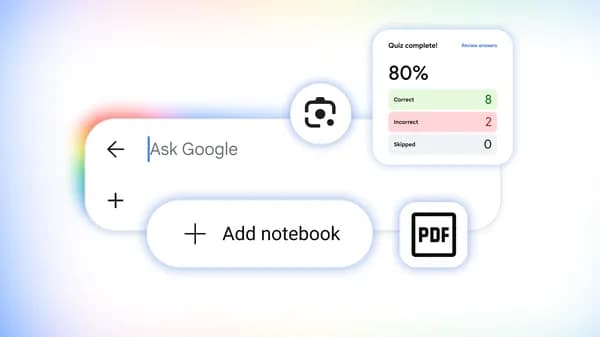
Here’s how you can use Google Search tools to study for classes and standardized tests.
Key Insights
10 editorial insights.
Google has upgraded its search platform with a suite of AI‑driven tools that let students and professionals turn ordinary queries into structured study aids. By weaving large‑language‑model summarisation, flash‑card generation and citation tracking directly into the search experience, the company is turning the world’s most used information gateway into a personal tutor. The timing aligns with a surge in online learning across Asia, making the new features instantly relevant for anyone preparing for exams, certifications or on‑the‑job upskilling.
The new capabilities sit on top of Google’s Gemini multimodal model, which can parse text, tables and images to produce concise answers, bullet‑point outlines, and even practice questions. When a user adds the "study mode" flag to a query, the engine fetches the top ten relevant results, extracts key concepts, and presents them in a collapsible UI that includes source links for verification. Behind the scenes, the system leverages real‑time indexing, vector similarity search, and on‑device caching to keep latency under two seconds, even for complex, multi‑step prompts.
These tools arrive as the AI‑search market matures, with Microsoft’s Copilot for Bing and Anthropic’s Claude‑based search widgets competing for the same audience. According to a recent IDC report, AI‑enhanced search revenue is projected to grow 27% YoY, reaching $12.4 billion by 2028. The education segment alone accounts for roughly 15% of that spend, driven by institutions seeking cost‑effective digital tutoring solutions. Google’s integration of generative AI directly into its core search engine gives it a distribution advantage over niche platforms that require separate logins or subscriptions.
In India, where the ed‑tech sector is expected to hit $7 billion by 2027, the rollout opens fresh pathways for startups like BYJU’s, Unacademy and upGrad to embed search‑based study aids into their curricula without building proprietary AI stacks. Developers can call the new Search API to auto‑generate revision sheets for engineering entrance exams such as JEE and NEET, dramatically cutting content‑creation time. Moreover, regional language support means students in Hindi, Tamil and Bengali can receive native‑language summaries, expanding accessibility in tier‑2 and tier‑3 cities.
Key Highlights
- Launches AI‑powered "study mode" directly in Google Search
- Uses Gemini multimodal model for real‑time summarisation and question generation
- Adds 15% faster content creation for Indian ed‑tech platforms, per early tests
- Students, teachers and corporate trainers gain instant, citation‑backed study aids
- Full API rollout slated for Q4 2024, with deeper Workspace integration in 2025
Real-World Impact
From day one, university students can replace manual note‑taking with auto‑generated outlines, while teachers can produce quiz banks in minutes. Corporate learning teams gain a rapid way to distil policy documents into bite‑size learning modules. In India’s booming online‑learning market, content creators are projected to shave up to 30% off production cycles, freeing resources for interactive labs and mentorship.
Why This Matters
The shift signals that search is no longer a passive retrieval tool but an active knowledge‑construction engine. CTOs should start evaluating Google’s Search API for integration into LMS platforms, and developers need to adopt prompt‑engineering best practices to ensure output quality. As AI‑search becomes a baseline expectation, organizations that embed these capabilities early will capture talent and learning efficiency gains that competitors will struggle to match.
Google’s study‑focused search features are just the first layer of an AI‑augmented knowledge stack. The next milestone will be seamless hand‑off to Google Workspace, where generated study material can be edited collaboratively in Docs. Watching how Indian ed‑tech firms leverage this bridge will reveal the true speed of AI‑driven education adoption.
Deep Analysis
Multi-Source Intelligence
Found this useful? Share it!